
Calvert County Arrest Warrants Explained
An arrest warrant is a written order that commands a peace officer to arrest a named person, and Maryland Rule 1-202 spells that out plainly. Who signs it depends on the court. In the District Court, a judge or a commissioner can sign. In the Circuit Court, a judge signs it, or the clerk issues it on a judge's recorded order. A Calvert County arrest warrant also rests on probable cause, meaning facts strong enough to support a reasonable belief that an offense occurred and that the person named is tied to it. Custody is what the warrant authorizes. The case itself gets decided later.
The Calvert County Probable-Cause Review
Most cases begin with a report. Police investigate, and when they file charges, the court and the State's Attorney's Office take over from there. Citizens have another route too. A person can apply directly for a statement of charges before a District Court commissioner when the police never file. The commissioner then reads the application and the supporting facts behind it. That review is the gate for a Calvert County arrest warrant. Without probable cause, no warrant issues, and a summons may come instead. What matters in this record is the written application, the affidavit, the judicial signature, and the issuing court.
When a Calvert Commissioner Issues a Warrant
Maryland Criminal Procedure § 2-607 lets a commissioner issue a summons or an arrest warrant after reviewing a statement of charges, but a warrant needs more than the charging paper itself. One of four listed circumstances must also exist: a prior failure to respond to a summons or citation, whereabouts unknown and needed to obtain jurisdiction, custody already held for another offense, or danger to a person or the community. That list explains why similar cases end differently. A Calvert County arrest warrant is never automatic. The reason sits in the charging record rather than in any public summary.
Inside a Calvert County Arrest Warrant
A Calvert County warrant is thinner than most people expect. The order itself is short. The case file around it carries the real detail, which is why the charging record and the warrant record stay separate in practice. That separation prevents the common mistake of treating a search result as the warrant itself.
| Case Number | The docket identifier for the Calvert County case |
|---|---|
| Warrant or Control No. | Where the form uses one; no fixed public format is published |
| Charging Document | The statement of charges or indictment describing the offense |
| Issuing Authority | The judge, commissioner, or clerk who signed the order |
| Bond and Conditions | Any amount or condition set when the warrant was issued |
| Receiving Agency | The office that received the process for service |
Personal descriptors travel on the court forms in a Calvert County case. The forms ask for name, date of birth, and similar identifiers.
Serving Arrest Warrants in Calvert County
The Calvert County Sheriff's warrant unit serves criminal warrants, child-support warrants, and criminal summonses. It also coordinates extraditions when a person is arrested in another state. Other agencies may hold process in their own cases, and the issuing clerk can say which agency received it.
Calvert County Sheriff's Office Warrant Unit
30 Church Street
Prince Frederick, MD 20678
410-535-2800
Once a person is in custody, Rule 1-361 requires an appearance before a judicial officer without unnecessary delay, and no later than 24 hours after arrest when the warrant gives no other instruction. The Circuit Court clerk's page publishes the courthouse contact block for circuit-level service questions in Calvert County.
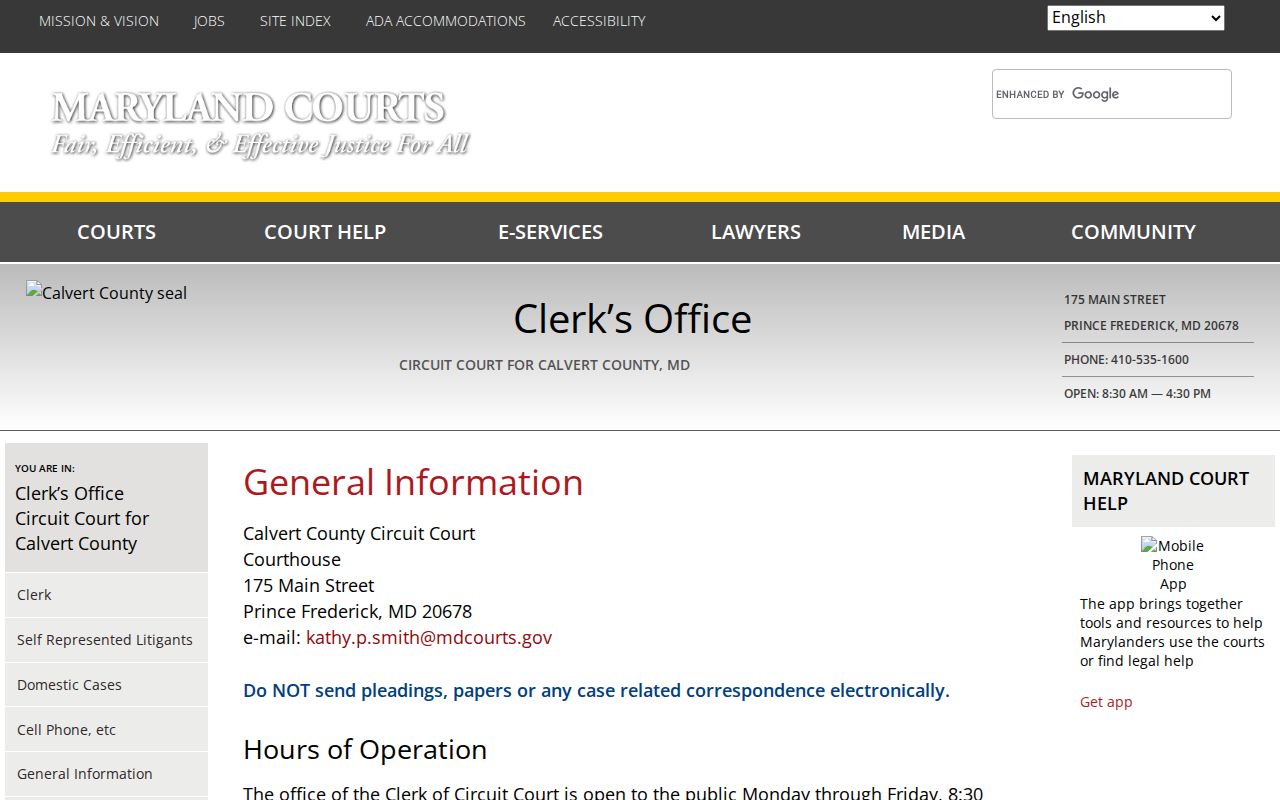
Circuit files hold the felony arrest warrants for Calvert County. The clerk's counters are where those case records get read.
Calvert County Warrant Unit Service and Extradition
The Calvert County warrant unit's duties reach past the county line. Its quarterly reports describe out-of-state extraditions, a multi-jurisdiction felony fugitive initiative, and cooperation with neighboring agencies and the detention center. An interstate detainer, in Maryland terms, is another state's charging document lodged with a correctional facility to hold a person for delivery. For a Calvert County arrest warrant, the serving agency can confirm whether process was received and whether service has happened, while the issuing court controls the legal status. Neither one can clear another state's warrant.
Comparing Arrest, Summons, and Bench Warrants
Three documents, three different meanings, and the differences decide what happens next.
| Point of Comparison | Arrest Warrant | Criminal Summons | Bench Warrant |
|---|---|---|---|
| What it does | Commands custody | Commands an appearance | Enforces an existing order |
| When it appears | At the start of a case | At the start of a case | After a missed date or violation |
| Who issues it | Judge or commissioner | Judge or commissioner | Judge on the case |
| Typical next step | Arrest and initial appearance | Appearance on the date shown | Preset bond, appearance, or recall |
A criminal summons can turn into a Calvert County bench warrant or an arrest warrant once the person fails to respond. Keep the original paper handy, because it shows which one you face.
Cash or Certified Check in Calvert County
Calvert County takes cash or a certified check for bail, and nothing else. Credit and debit cards are not accepted as bail payment in this county, a local restriction inside an otherwise statewide set of bail options. Property bail, intangible assets such as bank books or listed stock, and a licensed bondsman are described in state materials. Cash bail may be set in full or as a percentage. The posted amount comes back when the case is disposed or the appearance is made, but a failure to appear forfeits the cash and makes the full bail due. Ask the commissioner station where a Calvert County bond is accepted before you travel.
Calvert County Public Defender Intake
The Office of the Public Defender keeps a Calvert County office at 200 Duke Street, Room 2000, in Prince Frederick, with walk-in intake blocks in the morning and the afternoon. State guidance tells an eligible person to apply promptly after the first appearance and to bring the charging documents and proof of income. Know what intake is, though. It is a legal-assistance step, not a warrant check. A public defender cannot confirm a Calvert County arrest warrant over the counter, and applying does not change the warrant status.
If There's an Arrest Warrant for You
Get certainty first, then pick your ground. A Calvert County arrest warrant does not have to catch you off guard. Call the issuing court and the warrant unit before you do anything else. Ask about a scheduled walk-in, a preset bond amount, and whether the court will recall the warrant. Voluntary surrender, posting bond, and a motion to recall or quash all go smoother with a lawyer.
Important: Contact a licensed attorney before turning yourself in, because an open Calvert County arrest warrant can be served at any traffic stop.
- Write down the case number, the issuing court, and the name of the office that gave you the information.
- Ask the clerk whether a bond is set and where the accepted instrument is posted.
- Arrange counsel, or apply to the Public Defender if you may qualify.
- Confirm the surrender plan in advance so the appearance is scheduled rather than unplanned.
- Ask how the court will mark the warrant satisfied and get the next hearing date in writing.